What makes a wolf bold? When is that a problem? And when it is, what to do about it? These are questions Europeans have been discussing that have resulted in studies, an advisory document and an international conference over the past five years. These activities have been driven in part by the recolonization of wolves into parts of Europe from which they had been extirpated, and which are often now densely populated with human settlements.
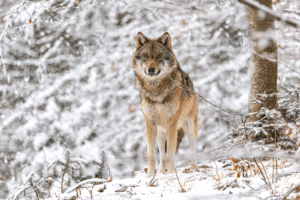 In research, as part of a larger project entitled “Concrete actions for maintaining wolves wild in anthropogenic landscapes of Europe,” two dozen authors studied and reported on the subject, and their findings were consistent with the work and recommendations of others.
Boldness was seen as part of a continuum of wolf behaviors, a stage beyond but related to habituation. The authors used a common definition of habituation, the “loss of natural reaction of alert after being repeatedly exposed to the same stimuli.” They note in the instance they are studying, the stimulus is “human presence and activities, for which (wolves) seem to have no positive or negative reaction, and which they ignore.” While neutral in itself, habituation exists on a continuum and at the extreme end, can cause harmful results.
Bold wolves were defined as animals that come within 30 meters (just under 100 feet) of humans. This is a neutral behavior unless the incursion into human space becomes repeated, which has been known to be a predictor of more dangerous behavior. Bold wolves were differentiated from those merely habituated to an environment in which they find food and are also considered separate from those that prey on domestic livestock. These are both situations in which wolves are seeking a meal, and in which solutions can allay the problem – securing food sources in one instance, and utilizing tools such as fladry, fencing and guard dogs in another. Similarly, wolves that are comfortable near cars and other mechanical equipment are not considered bold, as they do not appear to recognize the human element involved in the operation of the machinery.
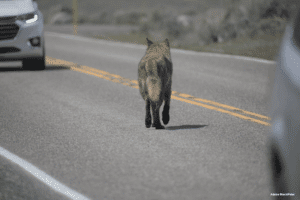 Bold wolves are considered a different concern from these other instances as the creatures invade the zone that people expect wild canids to avoid, vanishing at the approach of pedestrians or watching from what both humans and animals consider a safe distance. That behavior itself has been the topic of research, and dubbed the flight initiation distance (FID), to which wolves have been found to escape at the arrival of a human. A 2007 article in the Canadian Journal of Zoology reported on how far radio-collared wolves moved, following the approach of a human on foot. It found that “in the 34 experimental provocations, wolves moved away when the approaching human was between 17 and 310 meters (55.7 and 1017 feet) away. The mean FID was 106 meters (347.7 feet).” Subsequent studies in 2014 and 2022 supported these findings.
The authors cited research that included coyotes, foxes and wolves, noting that, as with habituation, terms like boldness or bold behavior are used inconsistently, but “there is general agreement that boldness is a trait that belongs to a continuum associated with the willingness to take risks.” Some authors connect boldness with reduced neophobia and responses to unfamiliar situations, while others believe it is exploratory behavior. Consistently, researchers urge examples of boldness to be examined on a case-by-case basis.
The scientists turned to instances of what might be boldness in the previous 10 years, across Europe. With nearly 400 reports, the group narrowed the pool to 20 cases, using the system developed by the Status and Conservation of the Alpine Lynx Population (SCALP) program, adjusted for wolves. The workers dismissed those instances which did not meet the criteria of repeated behavior, first-person accounts, closed (vs ongoing) cases, and sufficient information to rate the wolf’s behavior adequately.
There was great variability as well as several instances of similarity across the boldness cases. In 15 of 20, a single wolf was involved, while in another, five wolves from a single pack were. In 80% of cases the age of the wolf was known, and in 87% of those, it was young – a yearling or even, in three cases, a pup. This aligns with studies indicating that young and dispersing wolves are more likely to develop bold behavior than adults. In 10 cases the gender was known and evenly split between males and females.
Two wolves, one male and one female, had physical issues that made hunting difficult and might have driven them to boldness to procure food: the male had a spinal injury as well as parvovirus, mange and distemper; the female had a spleen abnormality.
There were signs in three cases that the wolves might have been captive previously – in one, rabies antibodies were present, but not rabies, indicating it was vaccinated; and in another, there were signs of wear around the neck, as from a collar. The third had unspecified signs of captivity that were not confirmed.
The 20 bold wolves came from a total of six nations: six each from Italy and Germany; three from Greece, two from Poland, and one each from the Czech Republic and the Netherlands.
Eighty-five percent of the cases occurred where wolves have recolonized vs where there has long been a population, consistent with the belief that humans might over-report problem wolves when they are unfamiliar with the animals’ normal behavior. On average, exhibition of bold behavior happened over 5.3 months. In all but two cases it occurred during the day.
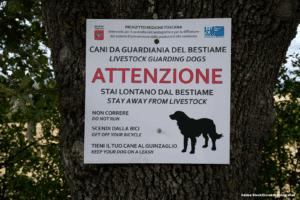
This sign, in German, translates into English and warns of the presence of livestock-guarding dogs.
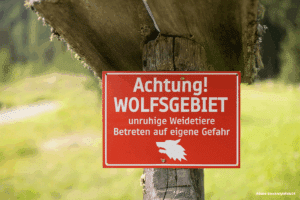
This sign in German translated to English reads: Attention: Wolf territory. Restless grazing animals. Enter at your own risk.
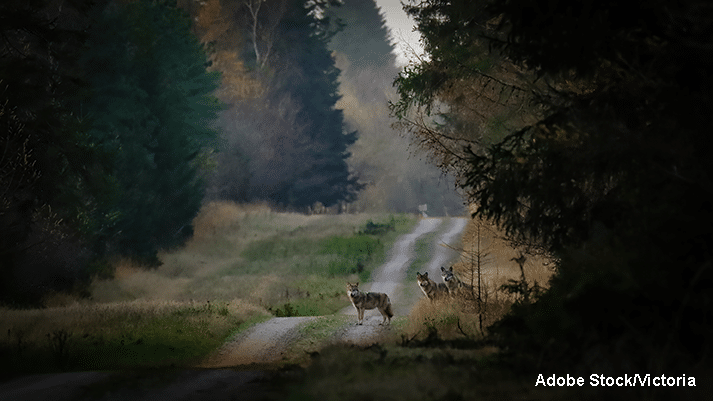
Situations in which folks report bold wolf behavior can be divided into two categories, the report notes: situations in which wolves really have acted in an unusually bold manner and situations in which human expectations of what is ‘normal’ do not correspond to how wolves normally behave.
In 70% of the bold wolf cases the distance from wolf to human was 0 to 5 meters (about 15 feet), and four cases involved actual contact (people were bitten; in one case the owner pulled a dog out of the wolf’s mouth). Those experiences included the three believed to have involved captive wolves and one that was highly food conditioned. Food and, or dogs, were the attractants in all but one case, where pups were inquisitive about the equipment of forest workers.
The research included the case studies of the 20 wolves, which in some instances were driven away with hazing devices. In others the wolves seemingly outgrew or became bored with the behavior and left on their own, and in other cases they were trapped and relocated. One wolf was killed in a highway accident and another starved to death before its situation could be addressed. In three cases, the wolf was legally shot.
The authors include a sample template to track boldness, with columns to record such factors as the presence of a leashed or free-roving dog, time of day, number of wolves, apparent size, gender, health and appearance, and behavior after attractants were identified and removed.
What might cause boldness other than youthful curiosity; dogs and food; and efforts at taming wild wolves in an urbanized setting? A 2020 technical paper produced by the Federal Documentation and Consultation Centre on Wolves (DBBW, in German), drew on wide international expertise to fulfill its role to advise federal and state authorities regarding wolves in the wild. The report dismisses the belief that boldness is more prevalent where the animal is not hunted, pointing to numerous examples across countries and species in which hunting did not play a part in suppressing bold behavior.
The paper examines the role of personality type, which behavioral researchers rank on a shyness -to-boldness continuum, saying “It is actually surprising” that wolves in human-dominated landscapes do not develop bold behavior more frequently. It cites studies that bold foxes drew closer to new stimuli than shyer ones, and that animals displaying curiosity and fearlessness are sensitive to new stimuli and can become habituated to it quickly. Perhaps, the report’s authors note, it is because wolves are cautious by nature and differ widely in their openness to new stimuli.
What did the authors suggest as a strategy for bold wolf management? Prevention, by discouraging humans from approaching or feeding wolves; documenting cases once they are identified; reacting to the situation by doing a field assessment, identifying and removing any attractants, and encouraging the public to share reports about the animal; and communicating with the public about the options available so if lethal force is required, people understand the issue.
Situations in which folks report bold wolf behavior can be divided into two categories, the report notes: situations in which wolves really have acted in an unusually bold manner and situations in which human expectations of what is “normal” do not correspond to how wolves normally behave. It is crucial to be able to assess whether a wolf’s behavior is truly bold or if the animal is behaving like any other wolf in a similar situation.
 This article was originally published in the Winter 2025 edition of International Wolf magazine, which is published quarterly by the International Wolf Center. The magazine is mailed exclusively to members of the Center.
To learn more about membership, click here.
Tracy O’Connell is a retired educator and writer who serves on the International Wolf magazine committee.