The Indian wolf has lost significant ground. Today its global numbers (estimated at 2,800 to 3,300) are fewer than those of the charismatic tiger.
By Dr. Yadvendradev Jhala
The gray wolf inhabiting the peninsular and western parts of the Indian subcontinent is no ordinary canid — it is the most ancient living lineage of its species, about 100,000 years older than wolves found in North America and Europe. It was as early as 2003 that modern molecular science discovered the Indian wolf to be a distinct and unique subspecies. Yet, it was only in 2025 that the International Union for the Conservation of Nature Canid Specialist Group did a separate red-list assessment of this wolf and classified it as vulnerable.
In the intervening 22 years, the Indian wolf has lost significant ground. Today its global numbers (estimated at 2,800 to 3,300) are fewer than those of the charismatic tiger. It also faces more threats than the tiger, which is on its way to recovery across India and Nepal. But now, a separate IUCN assessment spells a new ray of hope for the Indian wolf — since it is now recognized as distinct from other gray wolves, it will possibly get the required attention from the government and conservation agencies for decisions required for its conservation.
However, reversing the declining trend in wolf populations across India is not an easy task, as national parks and wildlife sanctuaries were primarily established there to protect forests. Indian wolves have evolved to exploit a niche that is not occupied by the large cats — tigers and leopards — and another social canid, the dhole (Asiatic wild dog), which is a forest dweller feeding on deer. The Indian wolves occupy grasslands, scrub, and open forests, feeding on antelope, gazelle, and hare.
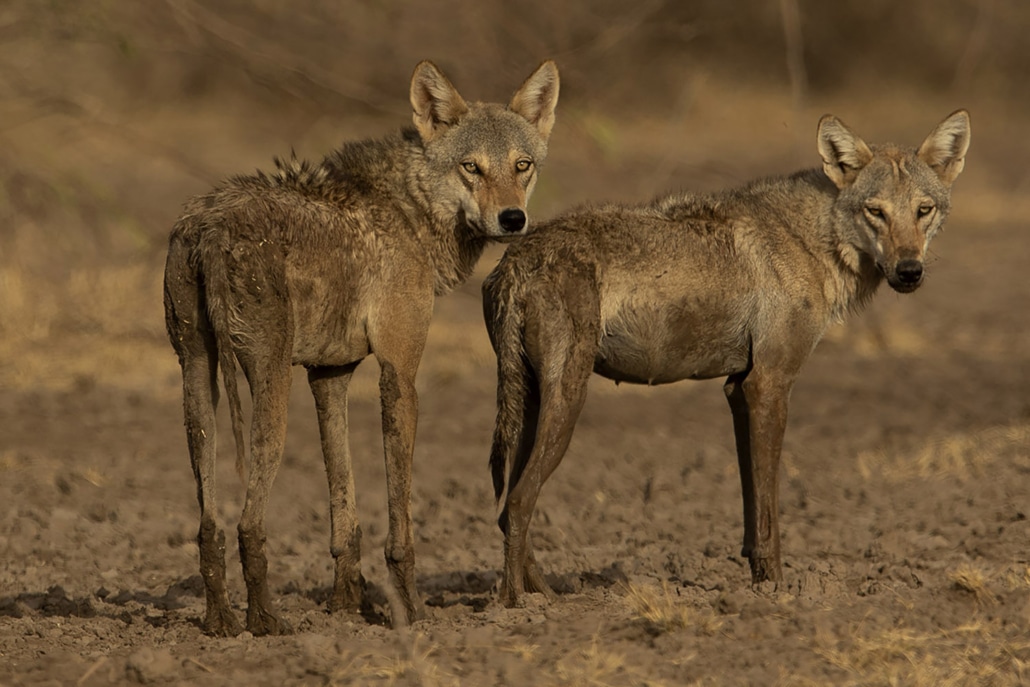
These wolf habitats were also inhabited by the Asiatic cheetah, which became extinct in India in the 1950s due to human persecution, natural prey depletion, and habitat loss. Indeed, much of the grassland and scrub habitat (that rarely became part of the protected area of independent India) has been put under the plow to feed 1.46 billion people. The wolf heads toward the same fate as cheetahs but has hung on due to its intelligence in avoiding being killed by people and its ability to hunt livestock at night.
Rural India sustains on an agro-pastoral economy, and the wolf is in direct conflict with human liveli-hoods. With the loss of its natural prey, most wolves subsist almost exclusively by predation on small livestock (sheep, goats, and calves) and by scavenging on cattle carcasses. Due to religious sentiments, India has a legal ban on the slaughter of cattle, and those that die naturally are dumped at specific locations, providing a bonanza of food resources for feral dogs and some wild carnivores like wolves, hyenas, and golden jackals.
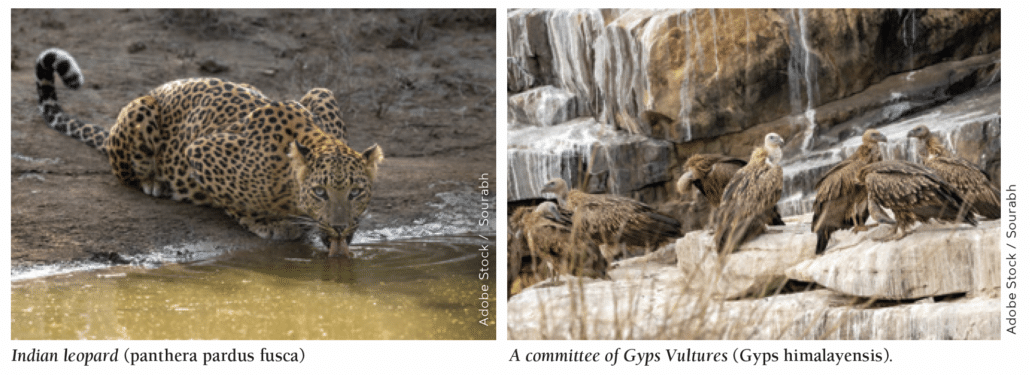
The superabundance of such carcasses sustained a large population of vultures of the genus Gyps, a flock of which could consume a carcass to the bone within hours and acted as ecosystem cleansers. Rarely did one see a rotting cattle carcass in the environment; the vultures and carnivores took care of it rapidly. The picked bones supported an industry of manufacturing agricultural fertilizers and bone charcoal, contributing to the rural economy.
In the late 1980s and 1990s, a new wonder drug, diclofenac (a nonsteroidal anti-inflammatory drug, or NSAID), was widely used by veterinarians to treat livestock. The Gyps vultures that fed on carcasses of cattle treated with diclofenac developed gout and died, causing a 97% crash in the vulture population of India within a decade. Though the Indian government banned the use of diclofenac in veterinary medicine in 2006, the damage was already done, and it will take several decades for the vultures to recover, if at all.
With lack of competition from vultures, the feral dog population has exploded in India. Feral dogs pose an ominous threat to wild wolves — they outcompete wolves at feeding sites (dump yards) that are usually near villages; spread diseases like distemper, rabies, and parvo virus; and most dangerous of all, they interbreed with wolves to swamp the wild wolf gene pool. Indeed, wolf-dog hybrids are on the increase across India, and unless hard decisions are made for controlling dog populations, the Indian wolf may be lost forever due to hybridization. This is similar to the fate of the red wolf hybridizing with coyotes in the southeastern United States.
“The wolf has been in this region for over 100,000 years, much before the first humans set foot on Indian soil. It has been their home much before it was ours.”
Controlling India’s large population of feral dogs (about 60 million) humanely needs substantial resources and scientific planning, which is unlikely to happen in the near future. What, then, is an alternative strategy to save the Indian wolves?
The tiger acts as a charismatic flagship for forest systems, and the Indian government has invested significantly for its conservation, creating some 58 reserves that act as source populations for tigers as well as other forest-dwelling wildlife. Unfortunately, the Indian wolf and its sympatric (inhabiting the same area) great Indian bustard (a large, long-legged ground bird) have failed to attract resources as flagships to conserve their habitats. (Currently, fewer than 120 great Indian bustards survive in a single population in the state of Rajasthan.)
Since 2009, conservationists realized that to save and restore areas outside of the tiger reserves, it would take another charismatic species. After a hard effort of 13 years, the courts and the Indian government were convinced, and the cheetah was reintroduced in India in 2022. Like the tiger, the charismatic cheetah caught the attention of senior bureaucrats and politicians, and the first three cheetahs were released on Indian soil by the prime minister of India.
Hopefully, the cheetah project will influence the decision to bring in the required resources to restore and protect wolf and bustard habitats across India. Project Cheetah will serve the same function as Project Tiger, but across neglected habitats and will assist in conserving species like the Indian wolf, great Indian bustard, caracal, and the striped hyena along with their prey, the blackbuck and Indian gazelle. These restored ecosystems would serve as source habitats for pure Indian wolf populations.
But much more needs to be done — legally, the wolf and the tiger have the same status as Schedule 1 species, protected by law. Killing or attempting to hunt a Schedule 1 species is punishable with a three- to seven-year jail sentence and a substantial fine. Several tiger poachers have been arrested and convicted, and due to this crackdown India has witnessed a 160% increase in tigers during the past two decades. While wolves continue to be persecuted, their dens smoked to kill pups, and their kills poisoned to wipe out entire packs, there has not been a single arrest for killing wolves in the past two decades, and the wolf population continues to decline.
When predators and people mix, there is bound to be conflict. How this conflict is perceived by people and resolved by wildlife managers decides the fate of carnivore populations and the potential for coexistence. Most often, when the conflict is severe and there is a negative perception, carnivore populations are locally extirpated.
With 1.46 billion people, India harbors one-sixth of the global human population, sharing space with about 3,700 tigers, 14,000 leopards, 22,500 elephants, and 900 lions. All are capable of killing humans. Annual human deaths on average attributed to large carnivores were around 250, while elephants alone were responsible for over 500 human deaths. Indeed, it is a surprise that large carnivores continue to exist in this region of South Asia despite high human densities, poverty, and high levels of lethal conflict.
Though this level of tolerance is a result of multiple factors, the most important single factor is the religious sentiment common across Hinduism, Jainism, and Buddhism that preaches human custodianship of nature in place of human dominion over nature. Though wildlife-caused mortality is significant in India compared to global averages, it is low compared to deaths by snake bites (over 58,000) and road accidents (over 170,000 per year).
In certain regions of India, sporadic attacks by wolves on children and the elderly have been reported in historical times. Since the 1980s, wolf attacks have been reported from three states: Bihar, Madhya Pradesh, and Uttar Pradesh. Wolves occur in 12 Indian states, and no wolf attacks are reported from the others. Fatal attacks by wolves account for about 0.5% of the carnivore-caused human mortality, yet the wolf is far more maligned than any other dangerous carnivore by sensational media reporting.
After an interval of almost 30 years, wolf attacks were again in the news in 2024-25, when wolves were blamed for about 19 human deaths, mostly of children, in the Bahraich region of the northern state of Uttar Pradesh bordering Nepal. Over the past two years, about 11 wolves have been either captured or killed from this region.
Common factors from all sites where wolf attacks have occurred since the 1980s are abject poverty of the communities, poor or lack of housing, absence of toilets, poor parental care, lack of wild prey, and livestock that is more heavily guarded compared to children. Under these circumstances, children and the elderly are vulnerable to any intelligent predator that is striving to survive.
The Indian wolf is small, with adult males weighing about 20 kilograms (44 pounds) and females 18 kilograms (40 pounds), and tries to avoid humans, let alone attack them. But in a densely populated region like Bahraich (about 1,800 people per square mile), there are few areas devoid of people. There, wolves subsist by scavenging livestock carcasses and feeding at garbage dump yards. Necessity brings them close to human settlements that are often scattered and continuous across the agricultural landscape. Unsupervised children abound, agricultural crops offer cover for predators almost up to the thatch huts, and toilets are essentially in the crop fields — a recipe for fatal attacks.
Removing wolves from the region is a short-term solution, as potentially some wolves have lost their fear of humans after successful predation on children, and their removal will stem the current attacks. However, the long-term permanent solution is to improve the economic status of the people in the region by providing proper housing facilities, electric lighting of settlements, and functional toilets. This alone will reduce the vulnerability to predator attacks and result in better opportunities for coexistence.
The wolf has been in this region for over 100,000 years, much before the first humans set foot on Indian soil. It had been their home much before it was ours. We need to ensure an environment where both humans and wolves can coexist with minimal conflict.
Dr. Jhala is the senior scientist of the Indian National Science Academy at the National Centre for Biological Sciences.
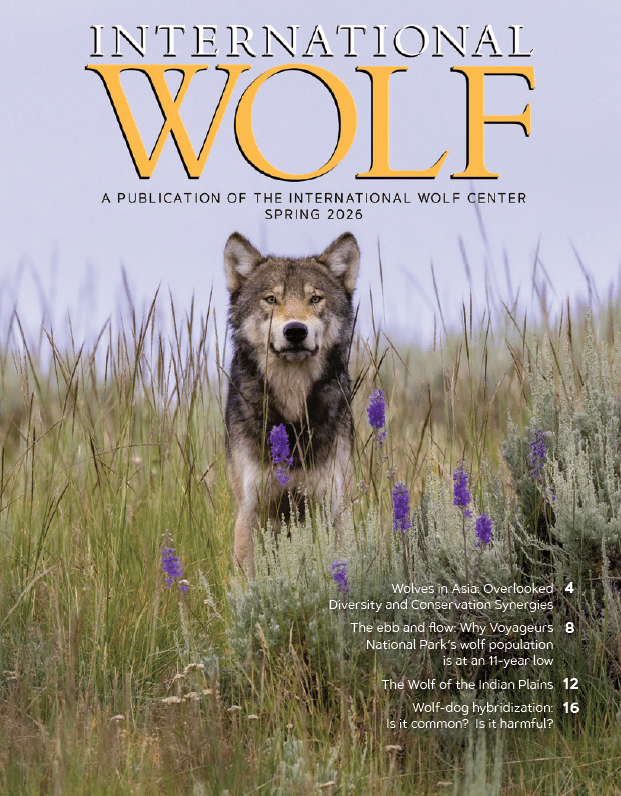 This article was originally published in the Spring 2026 edition of International Wolf magazine, which is published quarterly by the International Wolf Center. The magazine is mailed exclusively to members of the Center.
To learn more about membership, click here.