Using specially trained dogs, researchers are hunting for wolf scats with sea otter remains
By Kayla Fratt
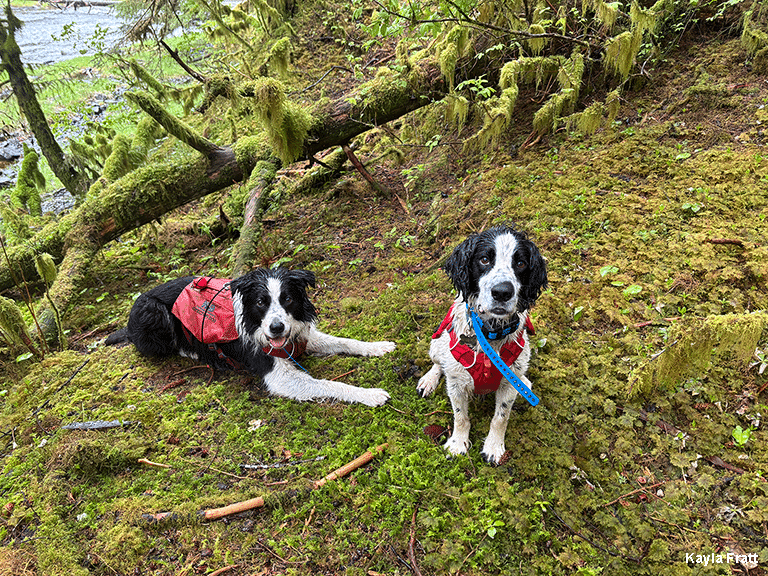
Barley (left) and Iitooma worked together to locate a scat on Sukkwan Island.
Clad in a matching wetsuit and lifejacket, Iitooma (ee-too-mah) curls up on my lap for a boat commute over the kelp forests of southeast Alaska. He snoozes while we skim past humpback whales, but stirs as soon as the boat’s engine cuts. He wiggles as I wrestle him into a red vest with a cheery bell and guide him to the boat’s bow. Most days, he just barely waits, tail wagging and lips quivering with anticipation as I wade to shore and cue him to leap down into my arms. We pick our way across the seaweed and to the base of a huge cedar tree. I radio the boat captain that all is well, take a few weather measurements, and ensure the GPS collar is functioning. Then Iitooma hears the magic word, “Search.”
He plunges into the dark old-growth forest, scampering across logs and over a thousand shades of green moss. His tail never stops moving as he sniffs rapidly, seeking the scent that means he’ll earn a game of fetch. I barely hang onto the end of a 30-foot bright orange line, carefully watching his body language for signs that he’s “in odor.” When he hits the edge of a plume of scent, his movement tightens, and his sniffing gets even louder. Suddenly, for the first time since he woke up, he’s still. Between his front paws is a pile of twisted fur: a wolf scat containing sea otter remains.
Iitooma, an English cocker spaniel, is a conservation detection dog trained to find wolf scats for research. The Alexander Archipelago wolf (Canis lupus nubilus) is a subspecies found in coastal Alaska and British Columbia. Our research centers in the southernmost corner of the Tongass National Forest, the largest in the United States. There, the Alexander Archipelago wolves have been challenging what we thought we knew about this species – specifically, that they require ungulate prey to thrive.
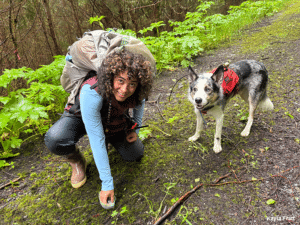
Field technician Nashaly Cortes collects a scat found by Niffler on Long Island.
Prior research on the Alexander Archipelago wolves found they can persist on marine diets after eating all the deer on a given island, resulting in record mercury levels in some individuals. These wolves are unique due to their reliance on sea otters and other marine prey. The wolves inhabiting the Prince of Wales Island complex also exhibit high levels of recent, historical and ancestral inbreeding and are of particular interest within the subspecies.
These wolves are also quite challenging to study. The terrain in southeast Alaska is steep, thickly treed and remote, which makes collaring or following wolves aerially very tricky. Previous efforts to estimate abundance and densities of the Prince of Wales complex wolves used standard VHF and GPS collar data in 1995, 2003, and 2012-18. Relying on collars to estimate the abundance of wolves in Southeast Alaska was so challenging that a 2016 paper concluded that “capture-and-radio collar approach is costly, imprecise, not statistically robust, and takes more staff time” when compared to noninvasive methods.
That’s where the dogs come in. Alongside his coworkers Barley and Niffler (border collies), Iitooma is an integral part of my PhD research at Oregon State University under the guidance of Dr. Taal Levi and Dr. Gretchen Roffler (Alaska Department of Fish and Game). Our work centers on the diet, movement and population health of the Alexander Archipelago wolf. These hard-working detection dogs sniff out the scats of their wolfy cousins in a unique twist on the cooperative hunting that dogs and humans have done for generations. Our mutualistic hunting strategy does not bring down mammoths or elk, but instead leads me to pile after stinky, hairy pile of data.
When the dogs find a scat, it is sub-sampled and frozen for genetic processing back at Oregon State University.
We can determine the prey contents of each scat and in samples that contain wolf DNA we are able to identify the individual donor wolf. These genetic techniques fall under the umbrella of next-generation sequencing (NGS) and are a specialty of Dr. Levi’s lab at Oregon State.
My PhD’s combination of using conservation detection dogs and NGS is no accident. Use of conservation detection dogs took off in the 1990s alongside a similar explosion in the use of noninvasive genotyping techniques. Finding lots of scats got much more useful when it became possible to identify species, prey contents and individuals with high accuracy through scat samples. It can be challenging to find the scats of cryptic, rare, elusive or wide-ranging species if you’re just a person walking through the woods.
Without enough samples, NGS is less compelling as a technique for understanding species or ecosystems. Conservation detection dogs offer a highly effective method for locating scat samples, making the dogs a valuable complement to the rapid development of fecal DNA analysis techniques. With proper selection and training, these dogs can be calibrated to work at high levels of specificity and sensitivity. After spending much of my 20s learning to train and handle conservation detection dogs on other projects, I am thrilled to link those skills with NGS and spatial analysis of Alaska’s island wolves.
Dogs like Iitooma can recognize their target odor from dozens of meters away. Odor movement, generally driven by wind, enhances detection-dog ability to locate tiny scats from small species, as well as scats that are off-trail, under thick underbrush, and even those buried by the depositor. My veteran dog Barley is notorious for finding scats that we rate as “impossible to see” on our data sheet – often nestled in the lower boughs of a bush that a wolf scent-marked at an intersection. Efficacy rates of conservation dogs vary based on myriad factors, including dog temperament, weather conditions, dog experience, dog-handler bond, handler experience, terrain, vegetation and target species behavior. All in all, conservation detection dogs out-performed other methods in 88.7% of published studies using dogs.
Iitooma, Barley, and Niffler are employed by the nonprofit K9 Conservationists; I am a co-founder and handler. Each dog works on several conservation projects involving the detection of hard-to-find biological samples like Humboldt marten scat, jaguar scat or bats killed by wind turbines. K9 Conservationists adopts high-energy, ball-crazy dogs that don’t fit into “normal pet homes” and then trains them to safely work around wildlife and livestock. Iitooma, Barley, and Niffler were trained using wolf scat samples donated by the International Wolf Center. The dogs quickly learn that sitting at the correct scat earns them a game of fetch. Months of fitness, problem-solving, and safety training prepares them for long and taxing projects.
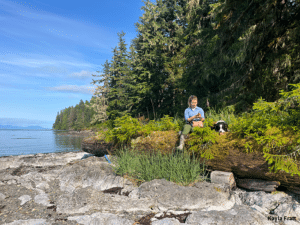
Kayla and Barley take a break and check the GPS during a survey on northern Prince of Wales Island.
The training is absolutely integral to dog safety, welfare and performance in Alaska. We spend long days picking our way over slash (woody debris, logs and branches left behind after logging) and through thick patches of salal or alders. We battle a prickly plant called Devil’s Club and side-step sharp barnacles in search of wolf scats. We take care to select dogs that prefer this sort of challenge to a walk in the park. This isn’t always easy; my younger dog Niffler looked fabulous in training for the Island Wolf Project but displayed a remarkable aversion to the fresh (unfrozen) wolf scats in the field. After several weeks of in-situ training and troubleshooting, I pulled him off the project.
An integral part to ethically working with dogs is listening to what they tell you. We can’t and won’t force dogs to do a job they do not love. Niffler is now happily employed as a wind farm specialist dog. Of course, these dogs aren’t content to just hold down the couch at the end of the field season. A huge part of my daily routine is maintenance training for the dogs. They are managed like an athletic team with fitness regimens, massage, training exercises and sports medicine appointments.
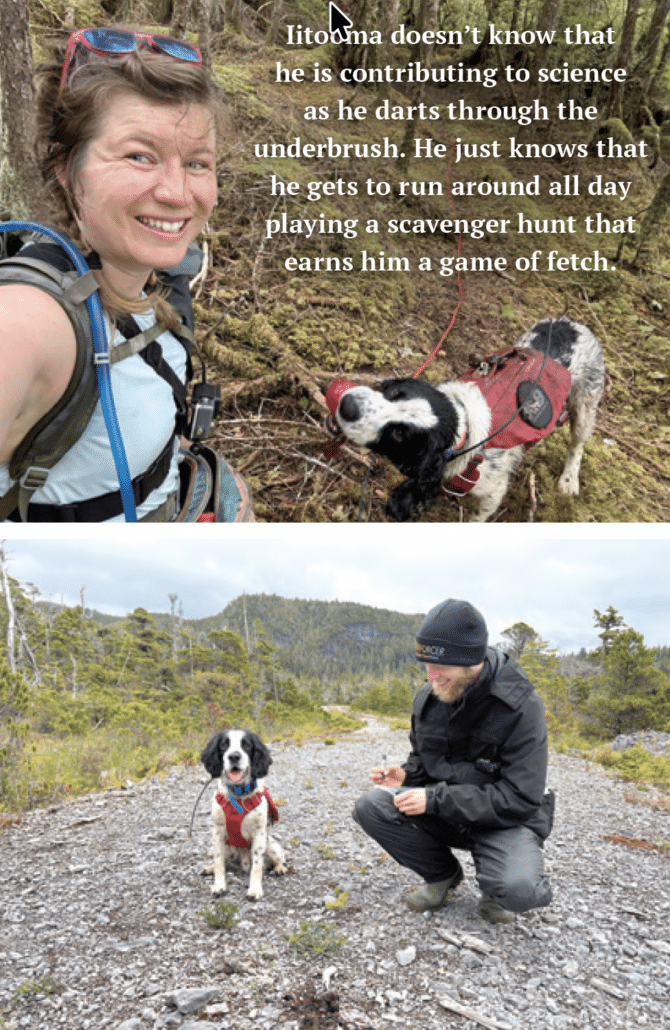
Top: Kayla rewards Iitooma for a find during a search on Goat Island. Bottom: Volunteer Robyn Strong takes data on a scat Iitooma found on Heceta Island.
Iitooma doesn’t know that he is contributing to science as he darts through the underbrush. He just knows that he gets to run around all day playing a scavenger hunt that earns him a game of fetch. But every scat that he finds helps put together a clearer picture of wolves in the Alexander Archipelago. In two years of fieldwork alongside the detection dogs, I have collected nearly 1,500 wolf scat samples for genetic analysis. During my first field season, my veteran detection dog Barley located 76% of the 779 wolf scats we collected. Initial genetic results show that most wolf scats contain Sitka black-tailed deer, followed by sea otter, birds, beaver, black bear, mustelids (a type of weasel), seals and sea lions, moose (only on Kuiu Island), rodents, salmon and other fishes. Initial results suggest the wolves are eating 33 different vertebrate prey items. We haven’t finished genotyping scats to identify individuals, but ultimately I will have three years of data showing the diet and location of wolves across 25 or more islands.
In this system diet, density, presence on small islands and connectivity are driven by a combination of island biogeography, prey diversity and abundance and foraging efficiency. The network of logging roads, patchwork of logging history and varying degrees of hunting and trapping pressure offer a complex combination of human impacts not always reflected in studies on wolves in protected areas. This research will allow us to examine a unique subspecies of wolf in a modified “working landscape” with ongoing and historic timber harvest with an exciting level of detail.
As I look forward to what we’ll learn about the Alexander Archipelago wolves, I am also grateful for what I’ve learned so far thanks to the detection dogs. My border collie Barley is moving into retirement; Iitooma is in training to step into his harness. After Niffler’s request for reassignment, I started to search for another working dog for next year’s roster. I have screened 42 and counting. Barley’s grit, tenacity and optimism in the field is remarkable. As I hang on for dear life to the end of Iitooma’s leash, it’s easy to miss the ease of working with a well-trained veteran dog.
Iitooma’s enthusiasm and energy is a double-edged sword. Alongside his success in searching for wolf scats, he struggles with long-term focus and excitability. It’s my responsibility as his trainer to troubleshoot and prepare him for a long, successful career. Onboarding the next generation of wolf scat detection dogs has not been easy, but the data they detect and the joy they exude at work is all worth it. So, with leash in hand, bear spray on my hip and backpack full of scats, I push the Devil’s Club aside and follow the dog’s nose.
 This article was originally published in the Winter 2025 edition of International Wolf magazine, which is published quarterly by the International Wolf Center. The magazine is mailed exclusively to members of the Center.
To learn more about membership, click here.
Kayla Fratt is a PhD student in the Department of Fisheries, Wildlife and Conservation at Oregon State University.