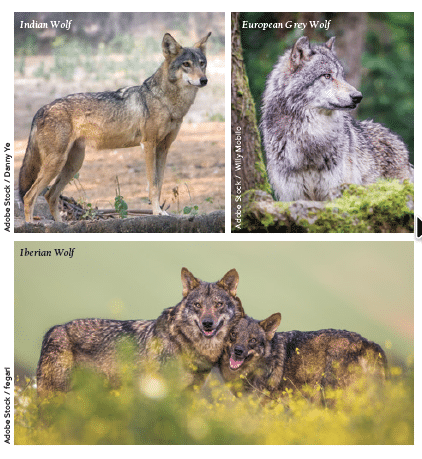
 Hybridization between wolves and dogs has been studied widely, often with attention to issues such as the spread of diseases such as parvo virus and rabies; competition for scarce resources; and predation.
A study by an international team of university researchers presented in the online journal Evolutionary Applications now addresses the matter of introgression – that is, the introduction of genetic material from one species (in this case, dogs) into the offspring of another (wolves). The team examined the extent to which admixture between dogs and wolves was present throughout the world and the degree to which dog genetic material might be affecting wild wolves.
In the research, titled Widespread, long‐term admixture between grey wolves and domestic dogs across Eurasia and its implications for the conservation status of hybrids, they utilized an existing dataset of 61,000 single nucleotide polymorphisms (SNPs) from wild canids and domestic dogs that had been previously used in studies of domestication, among other topics. SNPs are a type of DNA variations that can point to genetic differences among individuals. Researchers narrowed the initial data set to 252 animals: 54 Eastern European wolves, 20 Italian wolves, six Iberian wolves, 17 putative wolf–dog hybrids (nine from Eastern Europe and eight from Italy), 28 Asian wolves (five from Saudi Arabia, seven from Israel, two from Oman, one from Iran, three from India, and 10 from China), 125 dogs of different breeds (1–2 individuals per breed), and two free‐ranging non-breed dogs.
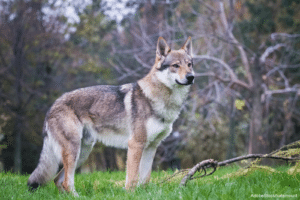
Czechoslovakian wolfdog
The study involved an analysis to identify groups of genes inherited together, which helps in understanding genetic diversity. The analysis included 38 chromosomes that carry genetic information responsible for traits and characteristics such as eye color and height with tests to analyze genetic variation within populations.
Results indicated there were individuals of mixed wolf–dog ancestry in most Eurasian wolf populations, and fewer instances in North America. Small blocks of dog ancestry were found in the genomes of 62% Eurasian wolves studied, the authors reported,Melanism, a marker for canine admixture, was also found, which suggests that “hybridization has been occurring in different parts of Eurasia on multiple timescales and is not solely a recent phenomenon.”
 Nevertheless, they add, wolf populations “have maintained genetic differentiation from dogs, suggesting that hybridization at a low frequency does not diminish distinctiveness of the wolf gene pool.” The authors point to other cases – avian, feline and ungulate – where hybridization resulted in changes in the native, free-living population due to an admixture introduced by a non-native or domestic species. They note the changes wrought from such breeding are not necessarily adverse.
Indeed, other studies have found unique, apparent outcomes of wolf-dog hybridization. The impact of melanism in wolves, often attributed to long-ago introgression from domestic dogs, has been associated with a heightened immune response to diseases such as distemper.
In an article published this year in Molecular Biology, an international team studied Iberian wolves, which they note “existed in a remote region for thousands of years alongside a population of loosely controlled dogs in a human-mediated landscape.”
Examination of 150 canid genomes of Iberian wolves, grey wolves from across Europe and Siberia, and dogs showed that Iberian wolves have virtually no recent dog admixture and less than 5% ancient admixture. Genetic introgression has nonetheless appeared to result in six genes that improve the wolves’ immune response and affect their brain function. This, the authors note, “may explain some of the unique behavioral phenotypes in Iberian wolves such as their reduced dispersal compared to other wolf populations.”
The international team, in the paper published in Evolutionary Applications, addresses the practical uses in wildlife conservation and the management of feral domestic populations that could arise from their work. They concluded that “increased hybridization frequency may be detrimental for wolf populations, stressing the need for genetic monitoring to assess the frequency and distribution of individuals resulting from recent admixture.”
 This article was originally published in the Spring 2026 edition of International Wolf magazine, which is published quarterly by the International Wolf Center. The magazine is mailed exclusively to members of the Center.
To learn more about membership, click here.
Tracy O’Connell is a retired educator and writer who serves on the International Wolf magazine committee.